Damper Wobble Noise


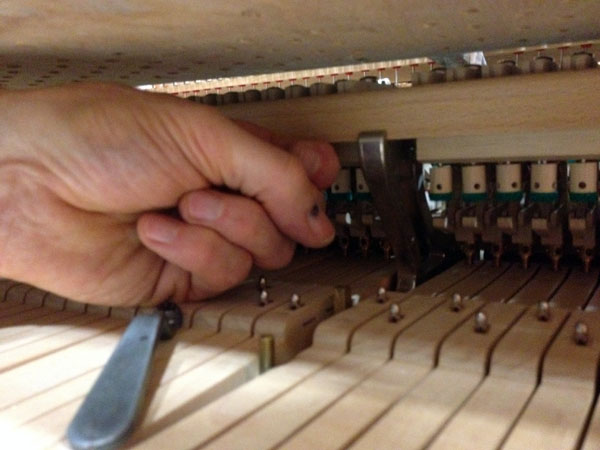
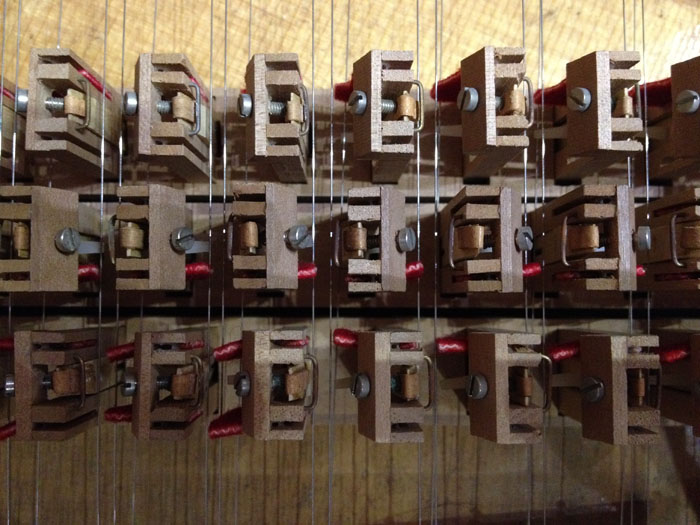
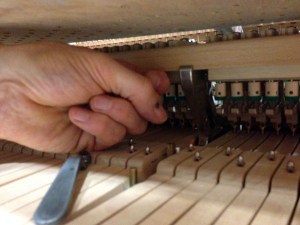
Sometimes dampers wobble as the key is pressed, especially on a hard blow, and can actually produce an audible vibration (a strange and annoying sound). Dampers with extended wires (usually at tenor/bass breaks) are particularly prone to this.

There are 2 remedies:

1 Replacing the wire guide felt.

2 Cutting back the damper head and re-cranking the damper wire (so that the damper head protrudes less, and so vibrates less).

Usually, both remedies are required – though as you can see from the pictures, only a 1.5mm thick sliver had to be removed, and the head sits just that amount closer to the plate arm…and now doesn’t vibrate!

Showing cut sliver (protruding)

Showing cut sliver (protruding)

The newly cranked wire

The newly cranked wire

First bass damper now closer

First bass damper now closer

Posted in Technical | Leave a comment

Dome Screw Adjustment


Many quality keyframes have Dome Screws to adjust how the frame rests on the keybed. Most dome screws are adjusted using a tuning hammer or special key.

Many Piano People do this on the work bench, using a straight-edge; some draw slips of paper between the dome screw surface and the keybed. Neither of these methods are reliable – or easy.

This is the best method:

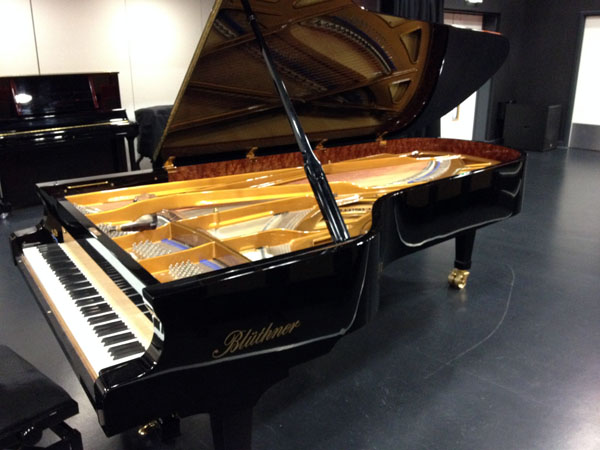
With the keyframe (and full action) in place on the keybed and cheek blocks screwed in position, tap obliquely down onto the key chasings close to each dome screw, lifting the keyframe as you tap (by pulling on the dome screw head or pressing up on the stack – as in the picture of a Bluthner concert grand) until you hear knocking (of the dome screw on the keybed).

Tapping the Chasings

Tapping the Chasings

The aim is to adjust each dome screw so that minimum lifting is required to produce knocking, thus putting as little tension into the keyframe as possible. Adjusting each dome screw may affect its neighbouring screw, so check up and down the keyframe several times.

For initial crude adjustment, try pressing down on the head of each dome screw. If this produces no visible movement of the hammers, the dome screw must be in firm contact with the keybed – and thus is either correctly adjusted or screwed down too far. Confirm this by tapping the chasing + gently lifting the stack. (if it’s screwed down much too far, it will be difficult/impossible to lift the keyframe clear, so you’ll get no knocking.)
Gap check: lifting the stack

Gap check: lifting the stack

Whereas, if pressing down reveals downward movement of the row of heads, there’s obviously a gap between dome screw and keybed: the screw must be turned down. Keep turning it down until the stack lift+chasing tap produce knocking. Now check neighbouring dome screws. Etc….

Sounds labourious? Once mastered, this method is quick and failsafe.

Posted in Technical | Leave a comment

Steinways Losing Weight


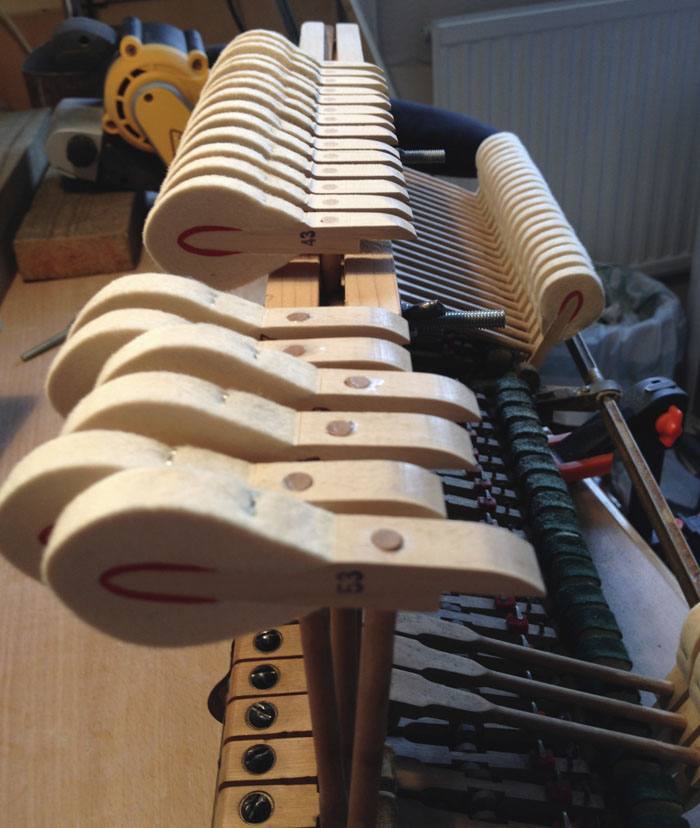
Size isn’t everything in the piano world….Because, though these hammers had a very good felt length and the correct width, they were far too HEAVY.

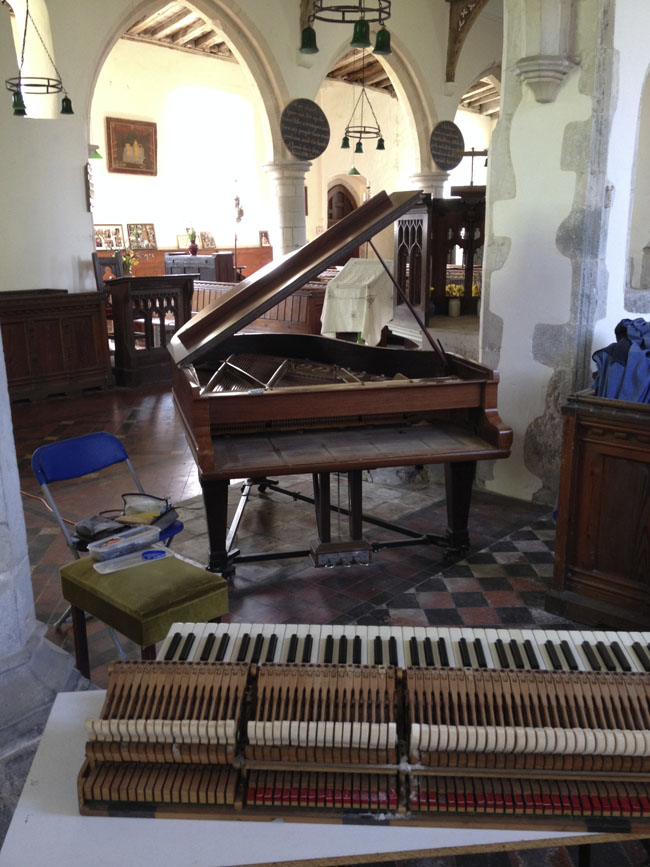
This early model O Steinway also lives in a Romney Marsh church, so stiff keys and sluggish everything else needed as much help as I could offer.

Marshland Steinway

Marshland Steinway

With keys already loaded to the hilt with lead, the only way forward was to lose as much of the hammer wood as possible. Time to get out the old sander…..

Hammer Tail Shaping/Reducing

Hammer Tail Shaping/Reducing

It wasn’t perfect – but after reducing the hammer wood, I managed to weigh out the keys to 48g. This is certainly better than the 65g + they were clunking at before!!

Posted in Technical | Leave a comment

Harpsichord Voicing: 1984 Horniblow


Harpsichord voicing, like FortePiano (Early Piano) voicing, is much more closely linked to the instrument’s regulation.

The process and principles of voicing, though, are the same for any instrument: giving form and equally graded variability to each and every note, throughout the range.

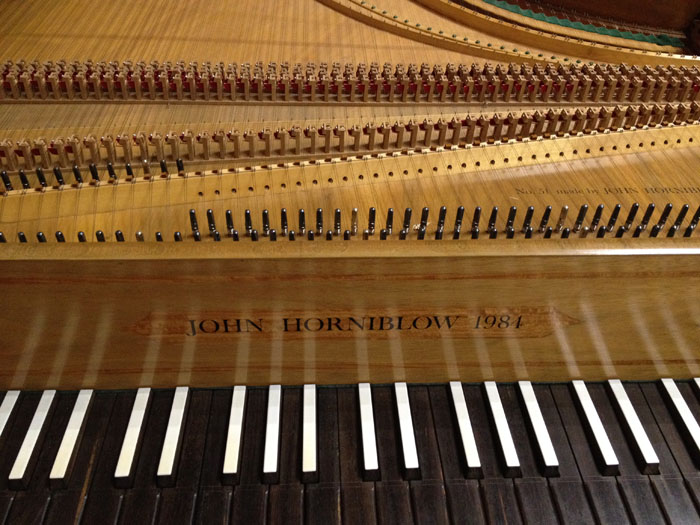
Voicing this 1984 Double Manual Harpsichord by John Horniblow was a delight, thanks to his excellent construction. There are 4 stops (2x 8′, 1x 4′, 1x 2′), so many Jacks and Plectra to work through….

A Superb Instrument

A Superb Instrument


Rich Jack Row

Rich Jack Row

Posted in Technical | Leave a comment

Hammer Cutting


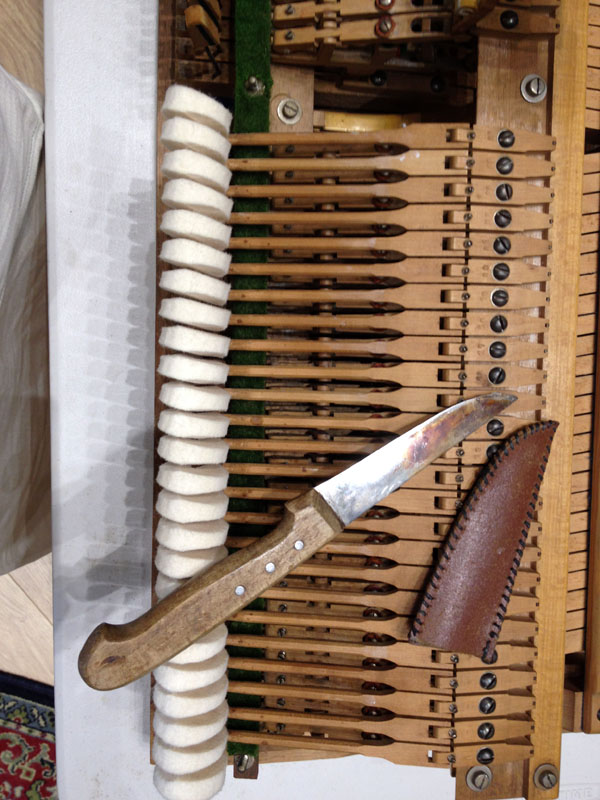
Sometimes, where hammers are angled on the shanks and there is little room, cutting bevels across the felts is the only way hammers will travel freely.

Bevelled Hammers

Bevelled Hammers


The Knife That Did

The Knife That Did

Having the right knife to do the cutting is essential – I made this one back in the 80s:

Posted in Technical | Leave a comment

Hammer Ironing


Once hammers are nicely profiled* they can be ironed. Ironing is not merely cosmetic: it ties in the exposed fibres, protecting the felts from dirt & dust.

*Ironing can also be used as a temporary (and very mild) way of firming up the hammers and the tone – especially when a piano is in a humid environment. In this case, the iron is drawn over the hammer sides.

front & back

front & back

pressing on a hot iron

pressing on a hot iron

Posted in Technical | Leave a comment

Blüthner Plate Bearing Bars


Sensible angles are built into this new Blüthner Concert Grand (compare the troublesome angles on a Grotrian Steinweg – ).

Good bearing angles

Good bearing angles

Good bearing angles

Good bearing angles

So, the tune-ability – hence tuning stability – of this piano is very good.

Not so, however, its set-up, which was nothing short of appalling! It took over 3 days’ solid work to bring the piano to its design potential: a very good concert instrument.

Splendid Bluthner Concert Grand

Splendid Bluthner Concert Grand

Posted in Technical | Leave a comment

Burn The Hammers You Don’t Like!


Burning hammers is a technical term: using a flame (or other warming) to alter the angle of each hammer on its shank.SPShammerburn2

Burning is done after Travelling. Travelling can only be done when hammer centres are working properly (more on hammer centres anon).

The hammer first in from the left (under my finger tips) looks like it needs burning, because it is not vertical on the hammer shank –

hammers needing to be burned!

hammers needing to be burned!


This is confirmed by lifting the hammer, comparing its position relative to its neighbours – ie at rest (pic above), hammer nose was nearer to the left; at lift (pic below), hammer tail is nearer to the right:

lift comparison

lift comparison

After burning, the hammer nose is now closer to the right:

done burning

done burning

Lifted, this is confirmed – the tail is similarly closer to the right (ie it is now positioned vertically on the hammer shank):

done burning confirmed

done burning confirmed


Done burnin them hammers! (well, that one, at least).

Posted in Technical | Leave a comment

New Hammer Profiling


Sometimes (as here on this Blüthner concert grand) new hammers are glued on, fitted only approximately to the strings and, it seems, the piano shoved out the workshop door – as if that were all that needed doing…. But new hammers need profiling just as much as worn hammers do (with much finer removal of felt).

This is because, if glued on simply as they arrive from the hammer manufacturer, the felts will remain bowed. And this is because hammers are cut, core wood & felt together, from one long piece. The release of tension across each hammer’s width as it is sliced off the long piece allows the felt to bow upwards, leaving each hammer looking as if it has ears.

The consequence of this is that the hammers do not meet the strings with their full surface area, striking the strings with less than half their potential power. Thus the piano seems weak, is not played much – and a vicious circle ensues wherein the hammer felts never reach their proper performing consistency due to not being struck hard and frequently enough.

In this picture, the hammers to the left are as I found them (fitted and unprofiled – with ‘ears’), those to the right are profiled to give level noses.

new wrong (left) & new right (right)

new wrong (left) & new right (right)

NB   The profiling was only done after the hammers were travelled & burned and correctly fitted to their corresponding strings (see next blog ‘Burn The Hammers You Don’t Like!’)

Posted in Technical | Leave a comment

Check-Hammer Alignment


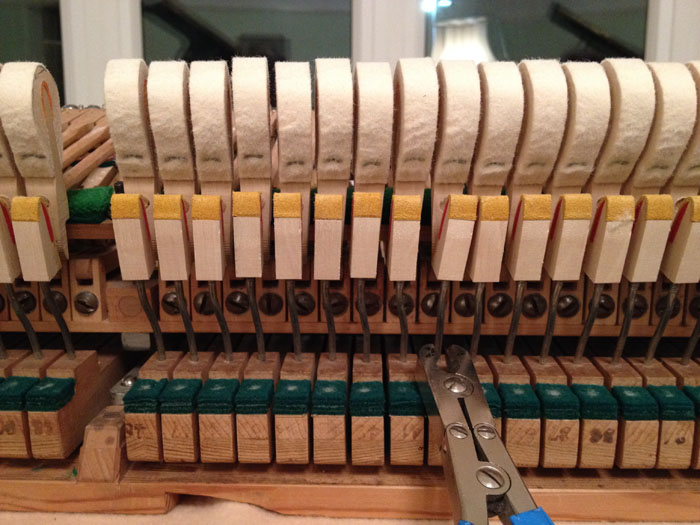
Once the hammers are aligned to the strings (and travelled & burned) – and, of course, the keys levelled & spaced (with any required straightening, via steaming or planing) – the checks can be aligned to the hammers (hammer tails), with particular care to avoiding interference with neighbouring hammers.

If it has been necessary to shift the hammers a long way, bending the checks can take a while – but correct alignment provides for efficient checking (and the fine adjustment of  checking distance, to be done later) and hammer release for repetition.

Aligning Check to Hammers

Aligning Checks to Hammers

Posted in Technical | Leave a comment