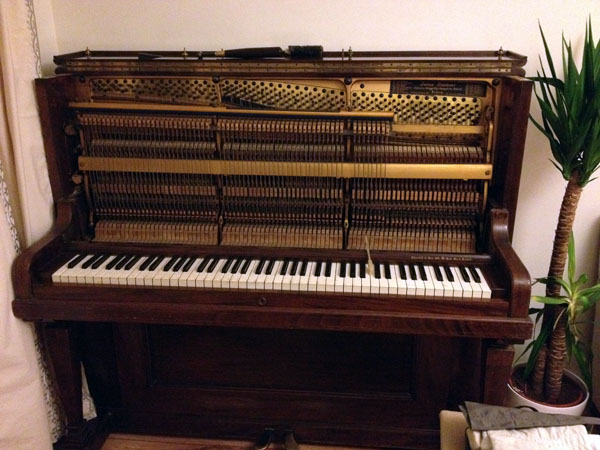
Half Blow


The Half Blow and its correct adjustment are vital to tonal control and evenness of touch weight (also this latter is primarily determined by appropriate Weighing Out of the keys – on this, more anon).

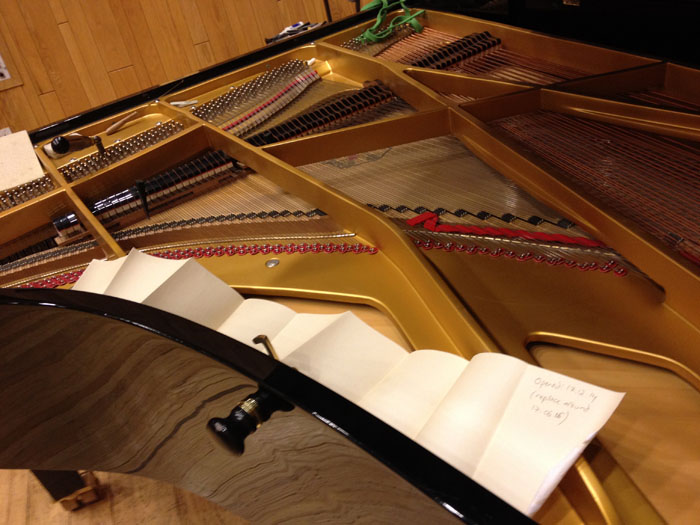
On sensible instruments (alas, not Steinways!) (though I did try to pursuade them otherwise…), spoons are fitted to the damper lift bodies for precise adjustment of individual key-damper interaction:
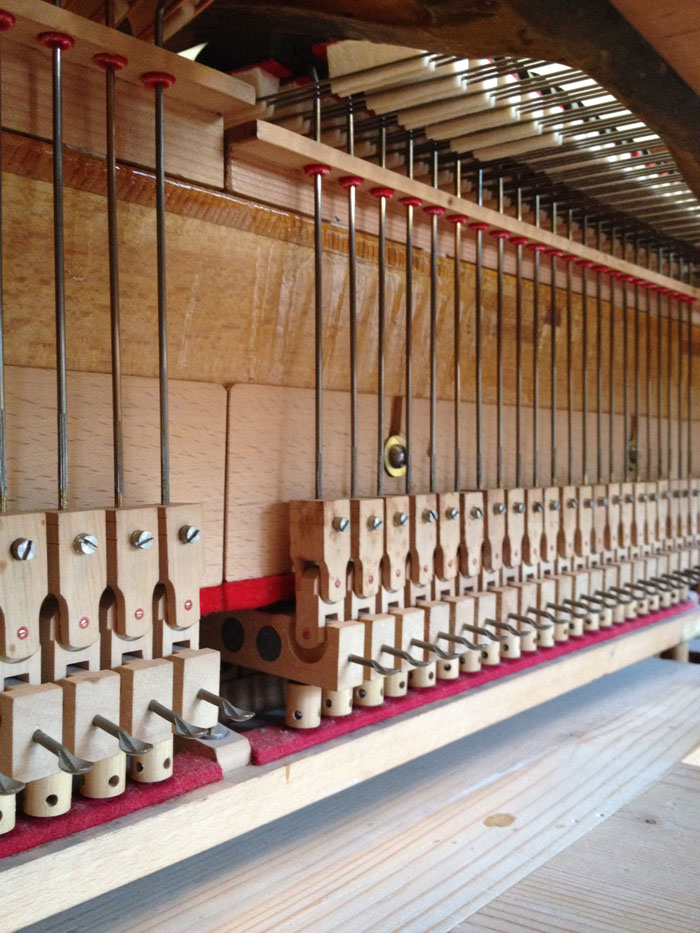
Boesendorfer damper lift spoons

Boesendorfer damper lift spoons


The required tools:

The lift transfer block & the spoon bender…
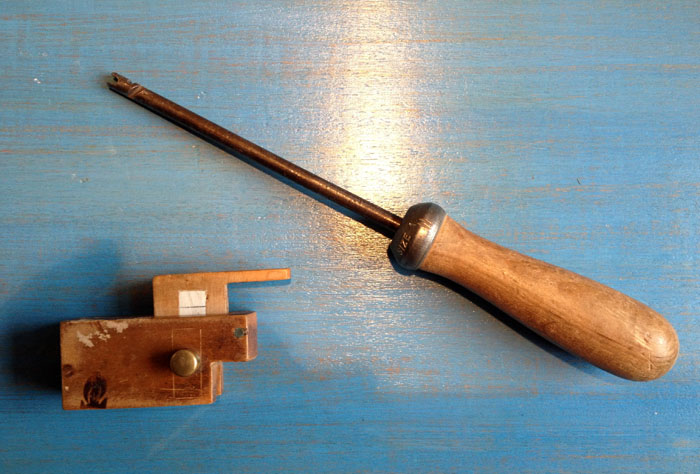
Transfer Block & Spoon Bender

Transfer Block & Spoon Bender
Posted in Technical | Leave a comment

Moth Damage III & Its Prevention


I could post pics of moth damage from nearly every piano I service – so ubiquitous is the problem now! (See other posts)

On this Yamaha C7 from the 1970s, the monsters had progressed from their usual starting place, the back-touch baize & underfelt, to continue feasting on the lever foot felts:

Moth Munching...

Moth Munch Crater…

The best recommended prevention is the placing of Rentokil Moth Repellent Strips (or equivalent) somewhere inside the piano, here shown on top of the plate (of a Grotrian-Steinweg concert grand):

Moth Repellent Strip

Moth Repellent Strip

Posted in Technical | 2 Comments

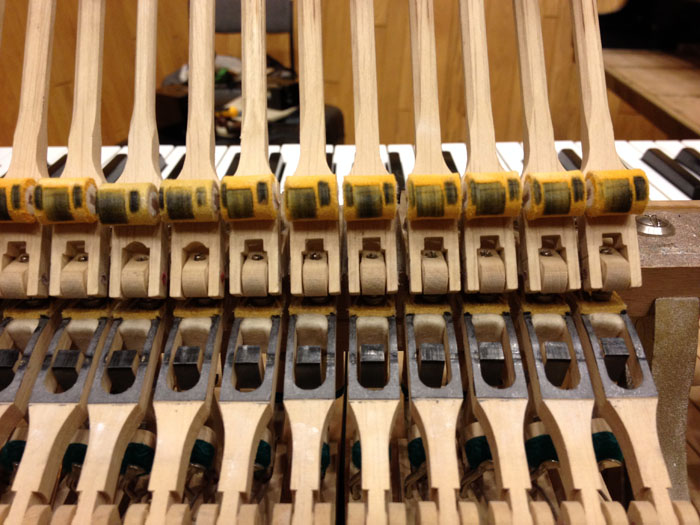
Lever-Roller Alignment


The alignment of levers & hammer rollers is, like all adjustable parameters in the regulation sequence**, essential to optimum function – which is in itself a prerequisite for the piano’s voicing.

See how bad most of these levers & hammers are, as evidenced by the black carbon lubricant markings on the roller leathers:

(Needless to say, sorting this lot needed some serious lever travelling)….

Lever-Roller Alignment

Lever-Roller Alignment

** Later in 2015, I will be publishing my Regulation Sequence for in-situ concert preparation.

Posted in Technical | Leave a comment

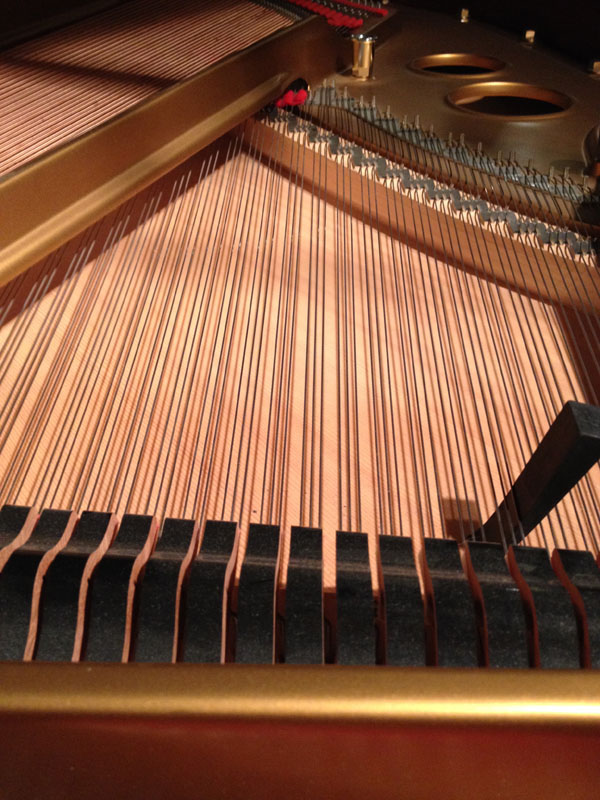
Steinway Duplex Scale


The Steinway Duplex scale, designed for its sympathetic resonance, can occasionally be too resonant – so that on this instrument (Steinway model O), I needed to weave in baize to the lowest of the (duplex) strings, because all the ‘C’ note dampers sounded like they weren’t working.

Steinway Duplex

Steinway Duplex

The local tuner and the recording engineers were baffled – and thought I was a genius to solve the problem!

‘Elementary’, I said….

Duplex Culprit

Duplex Culprit

Posted in Technical | Leave a comment

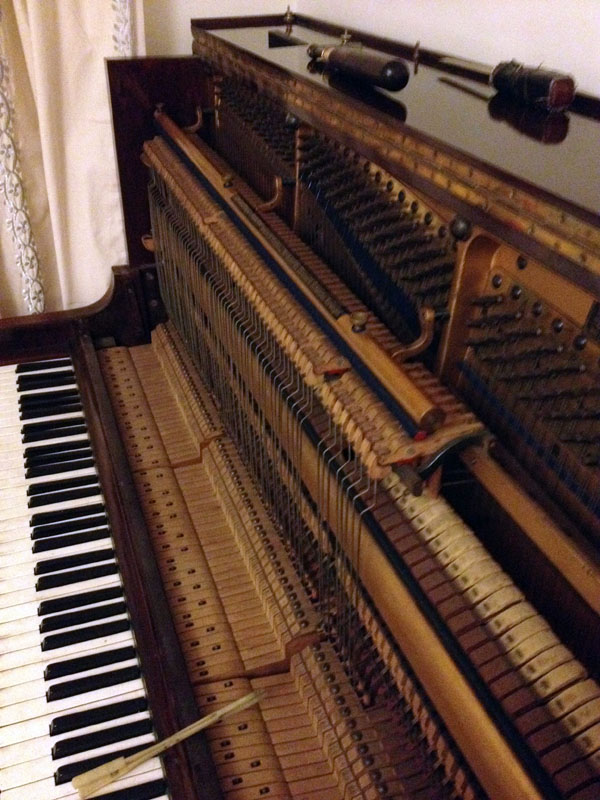
Bluthner Over-Damper


Another of the classic ‘best of’ models, this Bluthner O/D – often misguidedly dismissed as a second-class instrument, just because it uses the early style of damping in uprights: over-damping.

In fact, when built as superbly as this, with long keys, tall action and relatively large and efficient over-dampers, this action is much closer to the gravity -damper action of modern grand pianos – and so a more pianistic action than most Under-Damper Uprights.

Another World's Best?

Another World’s Best?

Bluthner Over-Damper

Bluthner Over-Damper

Posted in Technical | Leave a comment

Yamaha model X


Quite simply, one of the best uprights I have ever worked on:

World's Best?

World’s Best?

Posted in Technical | Leave a comment

Air Lyndhurst Steinway


Servicing the main Steinway at Air Studios. Basically, a very nice instrument requiring little more than my standard 2-day job. Nice job!

Mid-service at Air

Mid-service at Air

Posted in Technical | Leave a comment

Hammer Dope


In the Steinway factory (Hamburg) we used 2 kinds of hammer dope, the main one being a metal lacquer. This never really made sense to me, seeing as the stuff just dries concrete-hard – it’s just not very like hammer felt!

Much the most of the time, I avoid using dope, as there are other basic ways of hardening up the hammers. But recently, I invented a brilliant hammer dope that dries rubber-hard – much more like hammer felt!

Here’s a picture of my employing it on a Steinway model A in Rudolf Steiner House, London, in preparation for their new International Concert Series…..not that I’m going to give away the recipe!

Hammer doping at Rudolf Steiner House, London

Hammer doping at Rudolf Steiner House, London

Posted in Technical | Tagged , , | Leave a comment

Pleyel LEADS


Both the Damper Lift Body and Key LEADS on this 1840s Pleyel grand became oxidized (quite some time ago, I think!) – so that they were rubbing/blocking against each other.

The nasty (masked) job of filing the leads flush was inevitable:

Filing Leads

Filing Leads

1840 Pleyel Damper Lift

1840 Pleyel Damper Lift

Posted in Technical | Leave a comment

Odd Sound?


An odd string dullness confused me for a bit – until I looked at the proximal string, just where it passes under the Capo Tasto:SPScapota1

The splinter of wood caught between 2 strings is just visible (blurred in this pic) hanging as if between the damper wires. It was a simple fix – phew!

Posted in Technical | Leave a comment