Moth Attack II


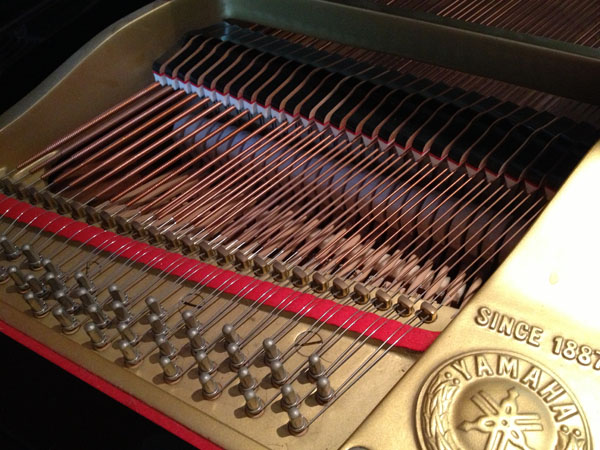
Moths always go for the most delectable felt – the felt only visible once the keys (and action) are removed: the back-touch and/or balance rail baizes.

mmmmoth yummy!

mmmmoth yummy!

no wonder the touch was odd!

no wonder the touch was odd!

Almost all pianos I visit now have some sign of moth, even if they haven’t started munching felt yet.


So, I’m recommending Rentokil’s moth repellent strips to be placed along the iron frame (grands) or inside the bottom door (uprights) – and replaced @ 6 month intervals:


Posted in Technical | Tagged | Leave a comment

Grotrian Steinweg Plate Bearing Bars


I like many Grotrian-Steinweg pianos – I was brought up with a 185 grand (from 1896) – but this new 2 metre something grand has proximal plate bearing bars that will become a tuner’s nightmare. (One of my friends recently described how he wakes up in a cold sweat, some mornings, thinking of the pianos he’s got to deal with that day!).

Gr-Steinweg bearing angle

Gr-Steinweg bearing angle

There is such a steep angle to the agraffes that the amount of tuning drag already requires the use of Protek lubricant (applied to the plate bar with a needle in tiny amounts – any excess wiped away). I expect to have to do this on some older pianos kept in poor conditions, but this plate design makes a piano old before its time!

Not good, Grotrian!SPSGr-SteinwegPbar2 (steep angle doesn’t show well on these pics).

Posted in Technical | Tagged | Leave a comment

Slippery Jack – Kawai


Pianos went thru a bad period of experimentation with various plastics – but Kawai came thru with a brilliant set up: all bearing parts use traditional felts/leathers, except the JACKS, which are the best jacks I’ve ever seen…

Kawai Super-Jacks

Kawai Super-Jacks

…Note the minimal wear on rollers – and absence of that darned black slippery stuff that usually gets absorbed, causing noise problems.

The jacks’ plastic is so slippery, it feels wet to touch. Release of the jack from the roller (set-off & aftertouch) is thus smooth and consistent throughout. And no need to rub up or treat the rollers!

In terms of their action & musicality of sound and responsiveness, all Kawai grands I’ve worked on in the last years beat ALL other non-European makes – as well as surpassing many European or American makes!

Well done, Kawai!

Posted in Technical | Leave a comment

Action Action


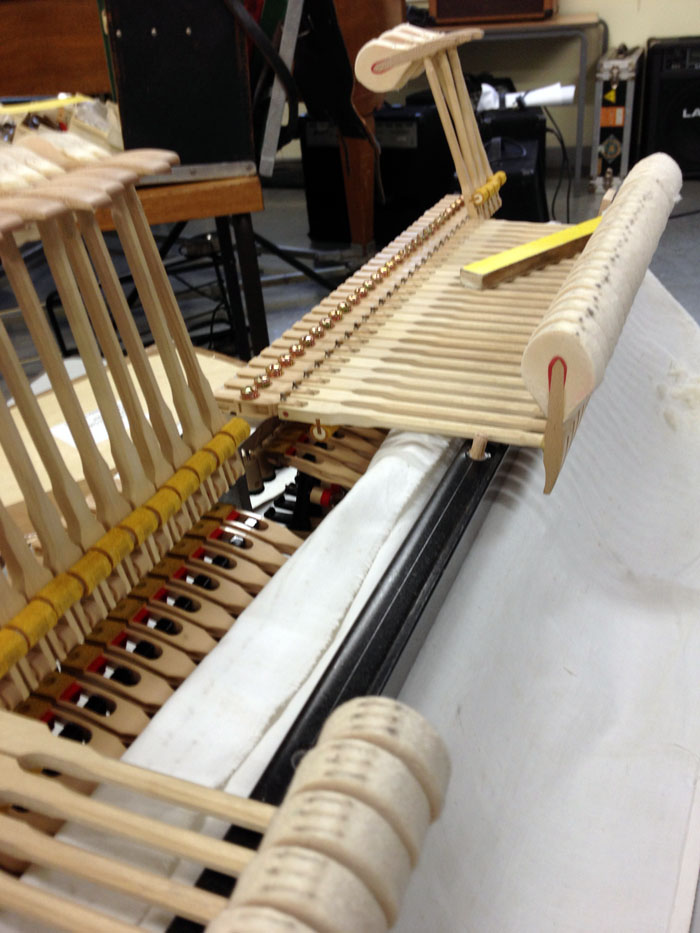
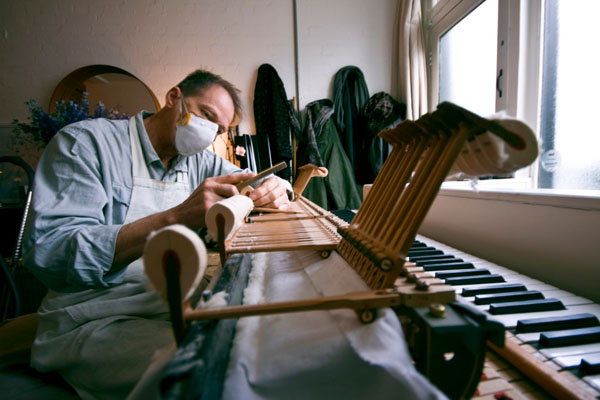
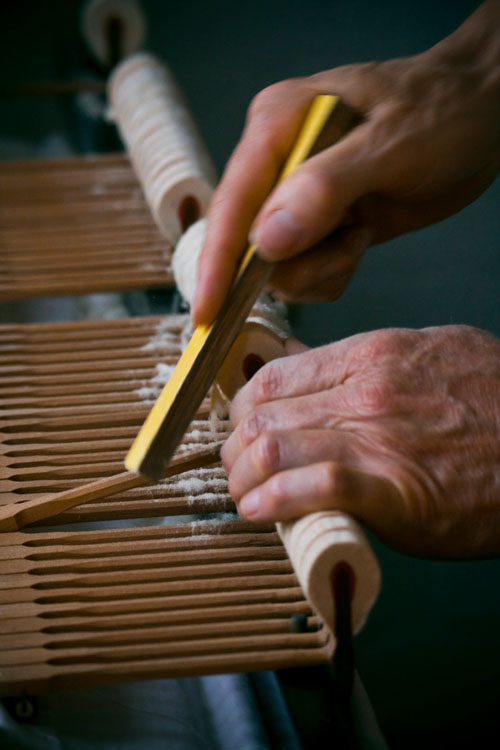
Action photos, by pianist-composer Pete Mauder of http://www.phonotheque.co.uk of me refacing the hammers on his Kawai grand.

A common feature of hammers become too flat is a lack of dynamic range and control (especially in attempting a pp). Doing my usual Maintenance Reprofile of the hammers, along with appropriate hammer needling (voicing), of course, restored Pete’s enjoyment of his piano – and hopefully inspiration for more of his precise compositions:

Maintenance reprofiling

Maintenance reprofiling

The file for the profile...

The file for the profile…

Posted in Technical | Tagged | 1 Comment

Equalising String Tension & String-Bridge Contact


Unstable tuning, buzzing/false strings can be greatly helped by these TWO OPERATIONS:

1/Pressing out the distal portion (between hitch pin & bridge) of each string;

2/ Tapping strings to the bridge (both sides of the bridge: distal & speaking length sides).

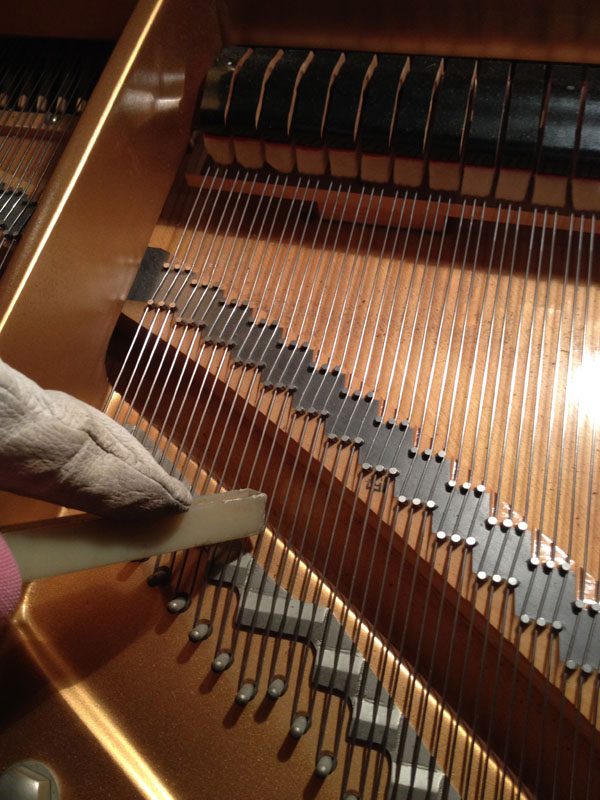
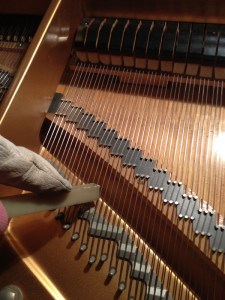
Here’s a pic showing use of a Papps wedge case to press through the distal portion on a Yamaha CFIII:
Pressing Out string tension

Pressing Out string tension

This procedure is necessary, of course, because string drag (thru bridge pin angle & over bridge) means that the distal portion moves least, and sometimes hardly at all – thus leading to a discrepancy in string tension in the various string portions. Though these procedures are usually done at times of manufacture and re-stringing, they are usually forgotten as an essential part of piano maintenance!

First press out the distal portion, then the speaking length. Follow with tapping strings into the bridge pin angle:
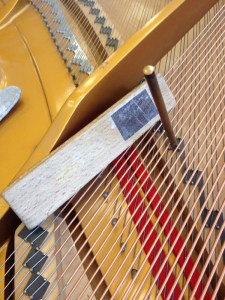
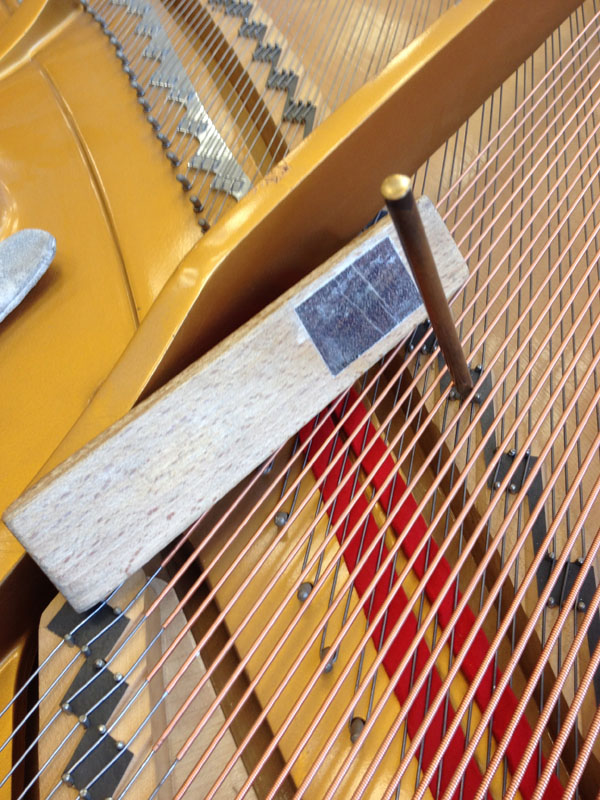
Tapping strings to bridge using wood block

Tapping strings to bridge using wood block

Do not tap strings too hard! For instance, a metal hammer/tuning hammer would have too much weight for this purpose, burrying the strings in the bridge (increasing drag/losing down-bearing/etc). Thus I use my voicing block, which is made of Beech with an inset piece of end-grain Bubinga as the mallet head!

I consider doing this as often as once a year! Recently, the procedure did not produce the expected tuning stability – so I repeated the whole process 2 months later – and the pressing thru’ left the strings 2-4 Hertz lower, revealing that pressing thru only once may indeed not be enough (I’d never noticed this before!).

Incidentally, tapping the strings a second time hardly showed any change.

Posted in Technical | 1 Comment

Zuckermann Harpsichord Bridge


In servicing this Zuckermann,

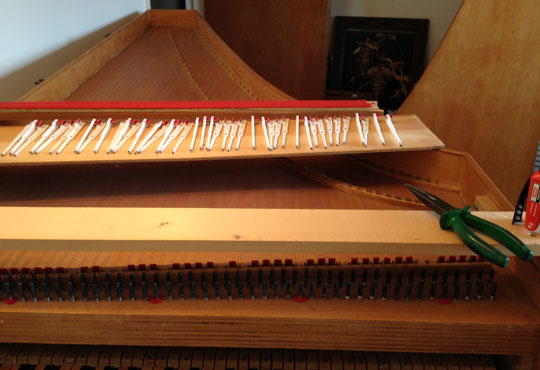
Jacks  awaiting regulation

Jacks awaiting regulation


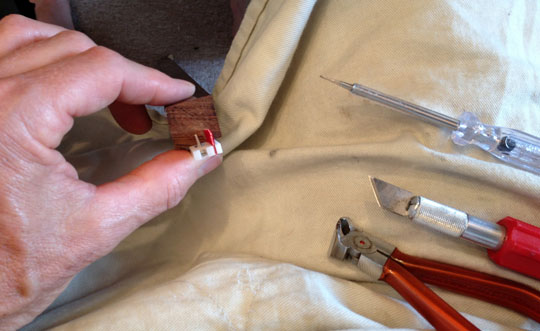
fitting new quills…

The Apron Workbench

The Apron Workbench

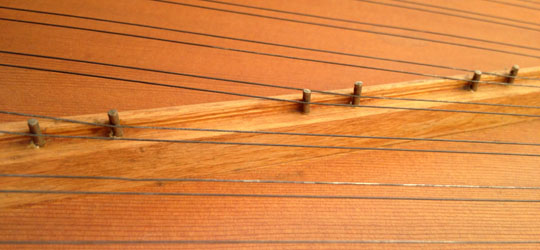
I remembered – just in time – that it’s essential to check the strings’ seating on the bridge:

Strings can ride up the pins

Strings can ride up the pins


because the strings can easily ride up the  bridge pins – and remain ‘hanging’ there. By the way, this is also just as true of pianos (though the movement is much smaller) – so tapping the strings into the bridge pin angle stabilises not only the tone and tuning, but also the regulation.


Posted in Technical | Leave a comment

Zuckermann Harpsichord Service


This may be only a kit harpsichord (I’ve made several of them myself), but it has a nice enough sound (hopefully better still, when I’ve finished with it!) and deserves the same rigour of set up as any instrument.

So, I’m working from the base upwards: key frame, key rest baize/felt, key levelling, key-jack adjustment felts – the latter seen here in the glueing & trimming process:

Sellotape as mini-clamps

Sellotape as clamp cousin (1st removed)

Posted in Technical | Leave a comment

String Rescue 2


The local technician had recommended a new set of bass strings. I went thus prepared to take a rubbing…

However, I did some tests on the very worst (either dead or buzzing) of them. None of those I tested had any added twists – one even had negative twist (ie in the wrong direction!). They revived well.

So, I added 3-4 twists to all the strings that were acoustically dull/buzzing. Again, none had added twists, whilst some had negative twist. (It is usual for string makers to add 1-2 twists to each bass string on fitting them).

I went on to revive the complete set, thus saving the pianist several hundred pounds!

NB: It is not possible to revive Hexacore strings (eg those used by Grotrian-Steinweg).

Here’s a pic of the set half way through the revival (most of those that look brighter have been twisted, thus showing a new side):

(Putting on individual new bass strings without changing all the other strings never sounds good – revived strings blend in, whereas new ones make for an unbalanced sound, which can’t really be compensated for via voicing)

the brighter strings have 3-4 added twists

the brighter strings have 3-4 added twists

Posted in Technical | Leave a comment

Steinway Key Lead Swellings


Sometimes the key leads oxidize and swell, even on Steinways. Mind you, the originals hadn’t swelled as much as those added after new hammers were put on. Still, they had all swelled a bit – and some enough to rub on neighbouring keys:

lead protruding 2mm

lead protruding 2m

Some keys have hideous amounts of lead in, so filing them flush with key sides is messy (nasty work, if you can get it!):SPSkeyleads3


Posted in Technical | Leave a comment

Sharp Levelling


I like to level the sharps once the ivories (plastics?) are done. On concert grands, like this Yamaha CFIII, I find 12.5mm is best. Smaller or older models of grand can work best with the sharps set as low as 10mm, but this +12.5mm (elevation above the naturals) is good for:

1- an aftertouch that feels similar to the naturals (the determining factor)

2- clear release of the jack

3- good finger pick-up (ie the pianist’s control)SPSsharplevel1

4- a touch depth that leaves the sharps above the surrounding naturals (at aftertouch). That is, lower +elevation of the sharps usually leaves them touching or even burrying below the surrounding naturals – not good!

Of course, pianist’s individual preferences may dictate further changes: some (especially those with small hands/short fingers) prefer the sharps set lower than 12.5mm, so that they can more easilly move up & down the keyboard when playing far ‘into’ they keys.

AND OF COURSEST, once the key levelling & elevation is done (together with all other action regulations), regulating the depth of touch for each individual key must follow…

Posted in Technical | Tagged | Leave a comment