Bluthner Patent Action


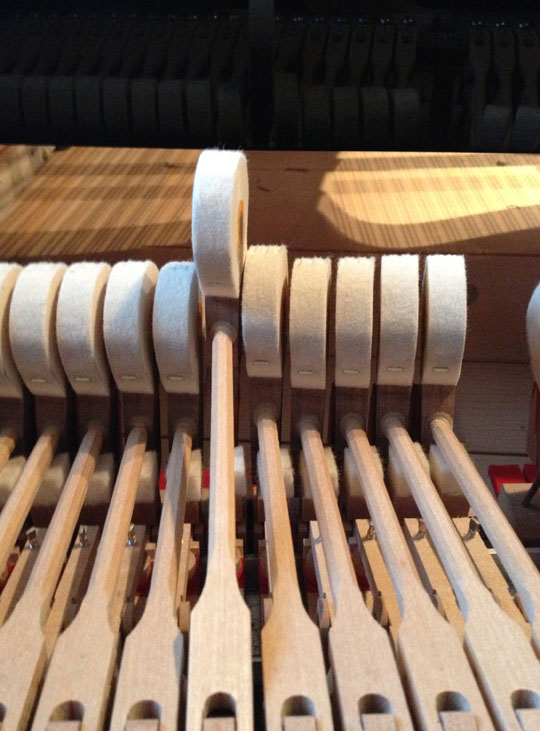
Keys were tight on this Bluthner Patent Action grand, and there was suspected moth damage, so I had to do the deed of removing the stack (which is easy – it’s just the re-fitting of the stack which takes some extra patience!).SPSBluthnerKeyFrame1
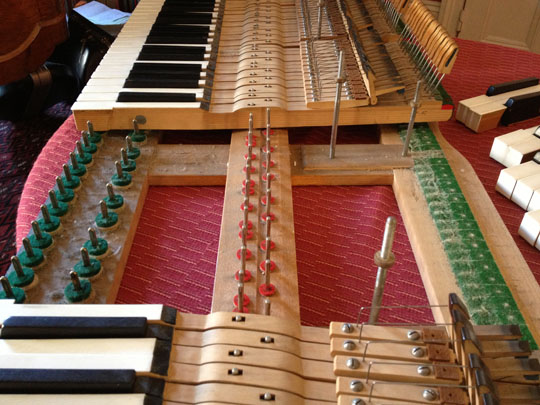
In fact, there was relatively little moth damage, but the keys couldn’t have properly been eased any other way:SPSBluthnerSticker1
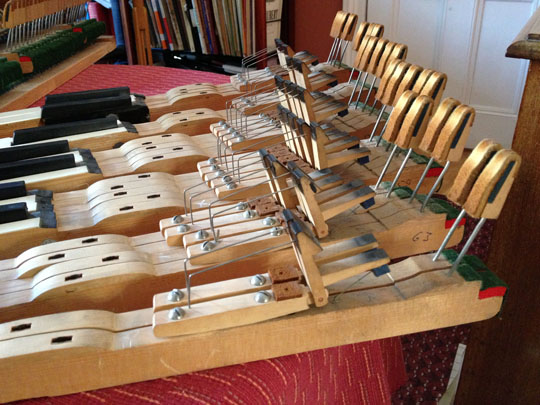
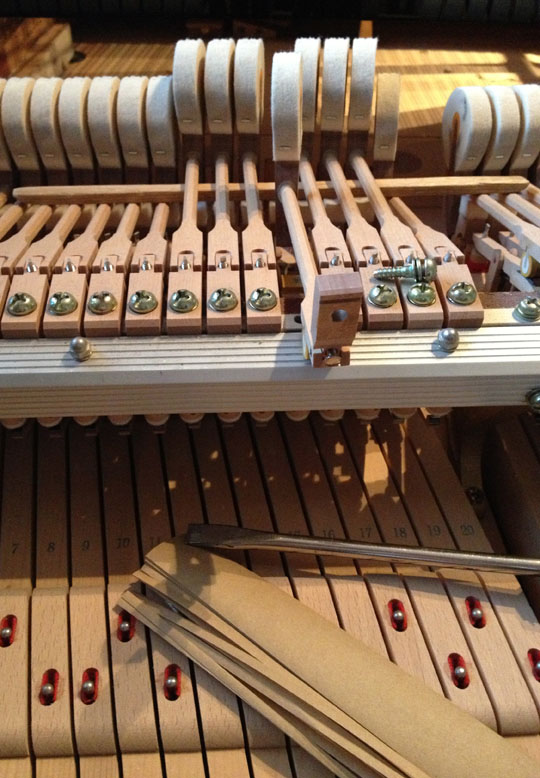
Also, doing a maintenance re-facing of the hammers was cleaner:SPSBluthnerHammer1Mind you, levelling the keys brought such a good starting point for regulating the action, I was glad I had cleaned the whole key frame in the first place:SPSKeyLevelBalance1
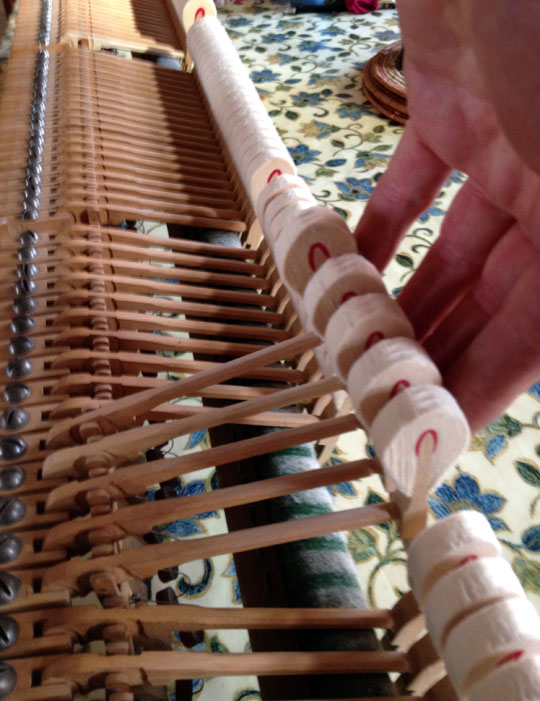
..as with a dust-free key frame (especially the balance rail), slipping in the specially prepared washers is straight-forward (almost!).

(Do email me if you can’t make sense of this photo!)

Posted in Technical | Tagged | Leave a comment

Broadwood Grand – worth restoring?


This rusty dusty old Broadwood grand is working AS IT IS.

But it’s a semitone below modern pitch (so A=415Hertz). So, it would be restricted to  accompanying some Baroque musics – which is OK in itself, but again…SPSBroadwoodStP2


…its hammers are so deeply worn that re-facing them would leave the relative dimensions & weights unworkable: they really need re-covering…SPSBroadwoodStP3


…So, in short, due to the costs involved, the probable prognosis for this piano is: leave it AS IT IS.

Posted in Technical | Tagged | Leave a comment

Hammer Travelling


On this very nice Yamaha CFIII-S, a few initial adjustments needed doing so that the pianist could play it for a while. A day’s service is to come later.

Tuning the Yamaha CFIII-S

Tuning the Yamaha CFIII-S

Meanwhile, one bass hammer (the B) is catching on its neighbour (the C):

Hammer Catching

Hammer Catching

But, as the hammers are not to be re-faced until the service, the solution to this wee problem must leave the B striking the strings exactly in the same place (otherwise, the hammer will try to ‘dance’ back into its old position, making a poor tone and weakening the centre pin).

My solution: move the C hammer’s resting position to the right, then travel it to the left – and a correct strike. (NB This is only acceptable as a temporary solution, as the C hammer now has a curved blow trajectory, which will ultimately affect its ability to produce a clean sound)

Hammer Travelling

Hammer Travelling

Thus, the B now has a clear blow (and everything sounds as before):

Clear Hammer Blow

Clear Hammer Blow

Posted in Technical | Tagged | Leave a comment

Moth Attack!!


Here is just one small and relatively very minor example of moth attack:SPSMothAttack1

Moths typically first go for the hidden bits of felt (like this key rest felt), but will happily munch their way through all the piano felts – including the hammers!!!

BE WARNED! If left untreated, moths can ruin your piano!

For a good 5 years now, I have been recommending all piano owners to buy good moth repellent treatment and see that it is regularly replaced.

Of course, also see that your technician regularly inspects the piano to check the treatment is working.

Rentokil do moth repellent strips. Strew the parchment-like (and odourless) strips somewhere inside the piano where they will not interfere with the action or sound production:

Uprights – inside the bottom door, in the pedal area.

Grands – on top of the plate (iron frame), along the curved side.

Posted in Technical | Tagged | Leave a comment

Tuning Pin Turning?


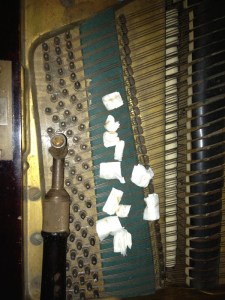
It took me one whole year to source a tuning lever (ie a tuning head attachment) small enough to turn all these tuning pins. They are of a size no longer available, so even my tuning lever’s smallest attachment wouldn’t turn all of them (ie not the worn pins).

So, whilst I could restore good regulation & tone to this baby grand, about one dozen strings had to wait 12 months before they could be restored to A=440 Hertz.

Thanks indeed to Mr George Veness, of The Stanhope Collection http://www.stanhopecollection.co.uk, for discovering the saving tuning head attachment at the bottom of one of his tool drawers!SPSWrestPinSize

(The white pads, made of tissue paper, were at last relieved of their task of muting the previously untuned strings!)

Posted in Technical | Tagged | Leave a comment

Bat Pin Turning


When the front key bushings get worn, the resulting wobble can be very off-putting for pianists (a bit like too much play on a car steering wheel).

Turning the bat pins can delay replacing the bushings by as much as several years, so it’s worth doing, especially as part of other operations (like easing the pilot holes, cleaning the key frame, levelling the keys).

Caution is needed, of course, to not make the pins run too tight on the bushings – otherwise keys may start sticking as humidity changes.SPSBatPins1SPSBatPins2

Posted in Technical | Tagged | Leave a comment

String Resuscitation


Dead-sounding bass strings (wound strings) can be revived, as long as they don’t look like they’ll snap if tension is released.

A full maul-to-maul resuscitation is required. Simply identify the culprit, release all tension, grab the eye windings with maul grip, lift off the hitch pin and turn 1-3 full turns in the direction of the winding.

This can re-instate an overtone rich sound to a string – and will last for at least several years.SPSStringResuscitation1 The resulting sound fits in well with the neighbouring strings – which is very preferable to the stark tonal difference of a newly made string (or badly selected string, like a hexacore string fitted into a round core set).

Posted in Technical | Tagged | Leave a comment

Lift Noise Felt Trimming


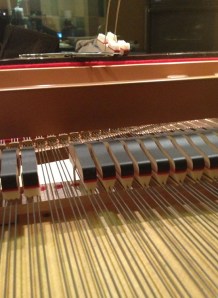
This time, trimming of the split wedge felts was needed because of excessive lift noise: when 20+ wedges are lifted together (using the pedal) quite a “zing” or “ghost” noise can be heard as the felts effectively collectively (and then effectively annoyingly) brush & strum the strings. This can amount to quite a loud and unwanted sound – especially in a recording studio where close mics are being used.

So, the same procedure as last time…..SPSDamperTrimming1

(The damper to the right has been trimmed – it’s important to round the ends of each wedge, not just shorten them)


SPSDamperTrimming2


SPSDamperTrimming3


The end result:

(In studio extremes, very precise trimming is required: the wedges almost rest ON the strings, protruding only very little between them – thus minimising lift noise).

Posted in Technical | Tagged , | Leave a comment

Damper Felt Trim


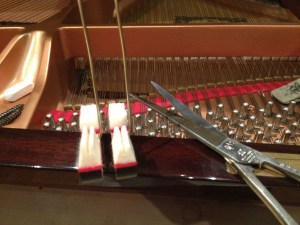
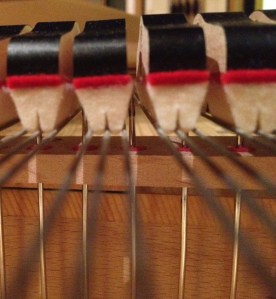
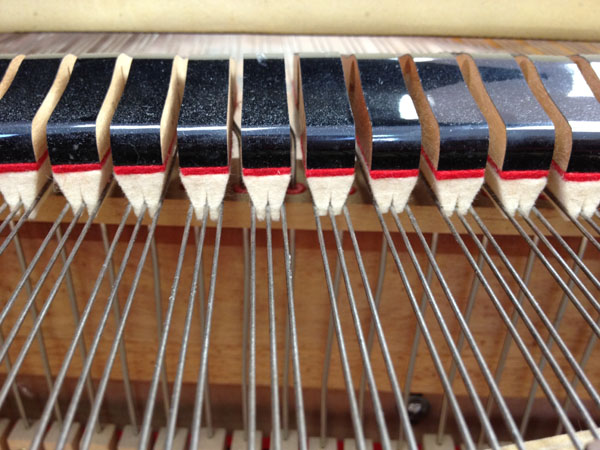
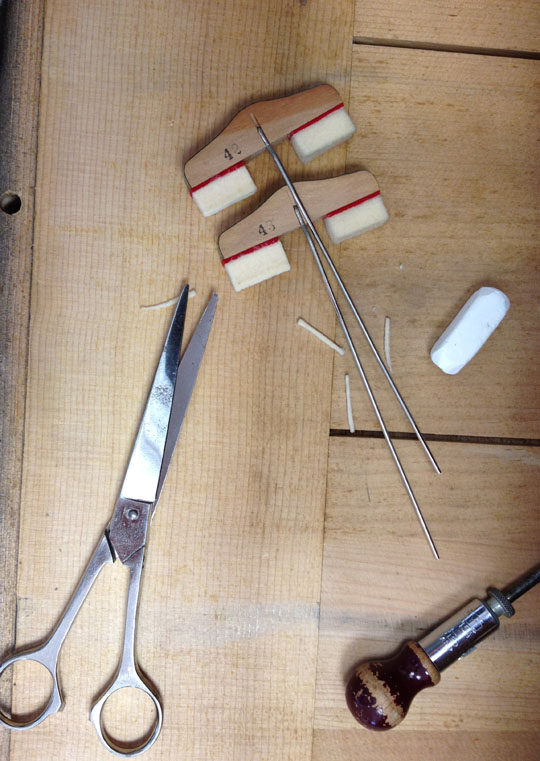
Damper felts, especially the split wedges, need trimming after some years of use. Typically, these Yamaha split wedges had become so long, they still hung between the strings (dampening them) when lifted by key or pedal. Further more (also especially typical of the split wedges) these dampers had settled lower & lower into the strings and were picking up too soon on the key (ie making the half blow too early), thus increasing the touch weight.

(So, as I was going to have to adjust them to pick up later, they were going to be lifted even less free of the strings, thus worsening the problem: there was no choice but to trim these felts).

If you look closely, you’ll see that the felts to the right have been trimmed, whilst the ones to the left are showing their typical badly increased length.

In the pic with the scissors, the top damper is the trimmed one; In the pic with my iPhone, the damper to the left is the trimmed one:

Posted in Technical | Tagged | Leave a comment

String Clean


A good String Clean can be done at any time of year!

All accessible parts of the non-wound strings can be rubbed down with a carborundum rubber. Of course, this doesn’t improve the sound, but it does reduce the collection of further rust and rust spots (which can form non-vibrating nodes that alter the harmonic picture of the string).

After this job, the sound board needs blowing out and carefully cleaning!

Posted in Technical | Tagged | Leave a comment